
You spray the room, it smells lovely for an hour, and then the same old odor creeps back. If that sounds familiar, you have met the difference between masking a smell and actually neutralizing it. They sound similar, but only one of them makes an odor go away. Understanding the gap is the single most useful thing you can know before you buy another spray.
What "masking" actually means
Masking is the strategy behind most conventional air fresheners, plug-ins, and scented sprays. They add a strong, pleasant fragrance on top of an existing odor so your nose notices the perfume first. Nothing is removed. The odor molecules are still floating in the air and clinging to your fabrics. The moment the added fragrance fades, the original smell is right where you left it.
There is a second problem with masking. Independent research has found that scented air-care products can release their own volatile organic compounds (VOCs) into your home, which is the opposite of what most people want when they are trying to make a space feel clean. We dig into that in Are Air Fresheners Toxic?
What "neutralizing" actually means
Neutralizing works on the odor itself. Instead of hiding the smell, a true odor eliminator changes or removes the odor-causing molecules so there is nothing left for your nose to detect. Once the source molecules are broken down or bound up, the smell does not come back when a fragrance fades, because there is no fragrance doing the heavy lifting in the first place.
There are a few legitimate ways products do this, from enzymes that break down the organic matter behind a smell to molecules that trap odor compounds. We break down each mechanism in How Odor Eliminators Actually Work.
Why masking keeps failing you
- The source is still there. Smells live in fabric, carpet, foam, and filters. Spraying perfume over them does not touch the source, so the odor outlasts the fragrance every time.
- It can make a room feel heavier, not cleaner. Layering perfume on top of odor often reads as "covered up" rather than fresh.
- It is a recurring cost. Because nothing is solved, you keep spraying. A neutralizer that handles the source means you spray less over time.
How Dr. Whiff approaches it
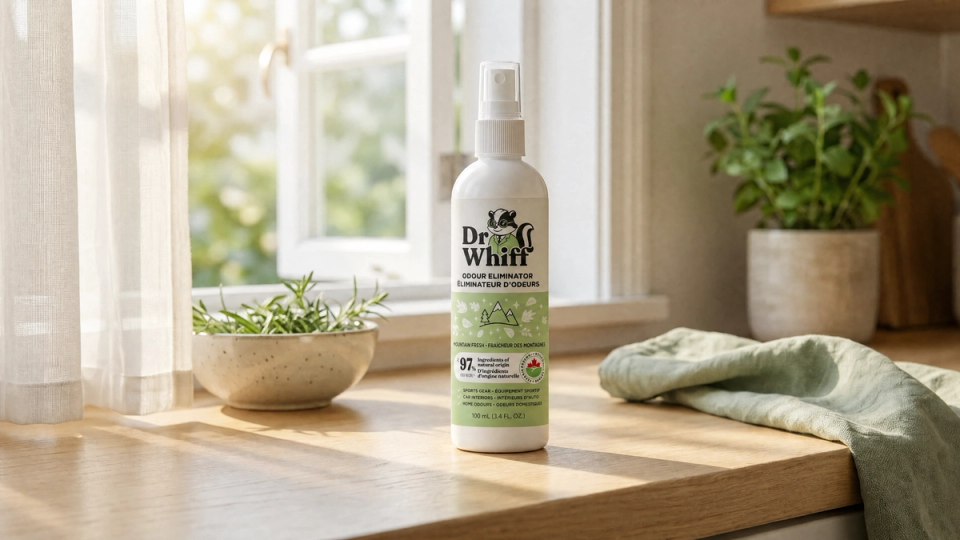
Dr. Whiff is built to neutralize, not mask. Our formulas use beneficial bacteria cultures to help break down odor-causing molecules rather than burying them under synthetic perfume. The ingredients are at least 97% naturally derived, with no phthalates and no petroleum-based carriers, and the scent is intentionally light so a room smells genuinely fresh instead of heavily perfumed. You can see the full ingredient story on our ingredients page and the science behind it on our odor science page.
How to tell a masker from a neutralizer on the shelf
- Read the promise. Words like "fresh scent" and "odor cover" point to masking. "Neutralizes" or "eliminates at the source" point to the real thing, especially when the brand explains the mechanism.
- Check the fragrance load. A heavy, long-lasting perfume is usually doing the covering. A lighter scent often signals the product is working on the odor itself.
- Look at where it can be used. Source-level neutralizers are typically safe on the fabrics and surfaces where odors actually live, not just sprayed into the air.
The bottom line
If a smell keeps coming back, you are almost certainly masking it. The fix is not a stronger fragrance, it is a product that removes the odor at the source. Start by figuring out where the smell is really coming from in What Actually Causes Bad Smells in Your Home, then choose a true neutralizer using our guide to the best natural odor eliminator spray.
Ready to stop covering smells up? Explore the Dr. Whiff lineup and neutralize odors where they actually live.