
"Odor eliminator" gets printed on a lot of bottles, but the products behind those words can work in completely different ways, and some barely work at all. To know what you are actually buying, it helps to understand the handful of mechanisms a product can use to deal with a smell. Once you can name them, the marketing gets a lot easier to read.
First, why we smell anything at all
Odors are airborne molecules. For something to have a smell, it has to be volatile enough to drift off a surface and reach the receptors inside your nose, which read the pattern and tell your brain "fresh laundry" or "gym bag." That single fact explains every approach below: a product can either stop those molecules from reaching your nose, or it can remove or change the molecules so there is nothing to detect. For the full chain of where smells come from, see What Actually Causes Bad Smells in Your Home.
The four ways products deal with a smell
1. Masking
The product adds fragrance to cover the odor. The molecules are still there. When the perfume fades, the smell returns. This is the most common and least effective approach, and we cover why in Neutralizing vs. Masking.
2. Absorbing and adsorbing
Materials like baking soda, activated charcoal, and zeolite physically pull odor molecules out of the air or hold them on their surface. This genuinely helps in a closed space such as a fridge or a drawer, but it is passive and slow, it has limited capacity, and it does little for odors soaked into fabric or foam.
3. Trapping
Some ingredients, such as cyclodextrins, are shaped to capture odor molecules inside a cage so they can no longer become airborne. The smell drops because the molecules are locked away rather than destroyed.
4. Breaking down the source (true neutralizing)
This is the deepest level. Enzymes and beneficial microbes break down the organic matter that produces a smell, such as the sweat residue, urine, or food spills that bacteria feed on. By digesting the source, they remove the supply of odor molecules instead of fighting them one by one. This is why source-level approaches keep working after they dry, while masking does not.
What "naturally derived" does and does not mean
A natural origin is great, but it is not the same as proof that a product removes odors. There is no single regulated definition of "natural," and some botanical sprays still work mostly by masking. The thing to look for is a clear, explained mechanism for removing odor at the source, ideally paired with a naturally derived formula. Natural and effective are both worth having, and you do not have to choose.
How Dr. Whiff works
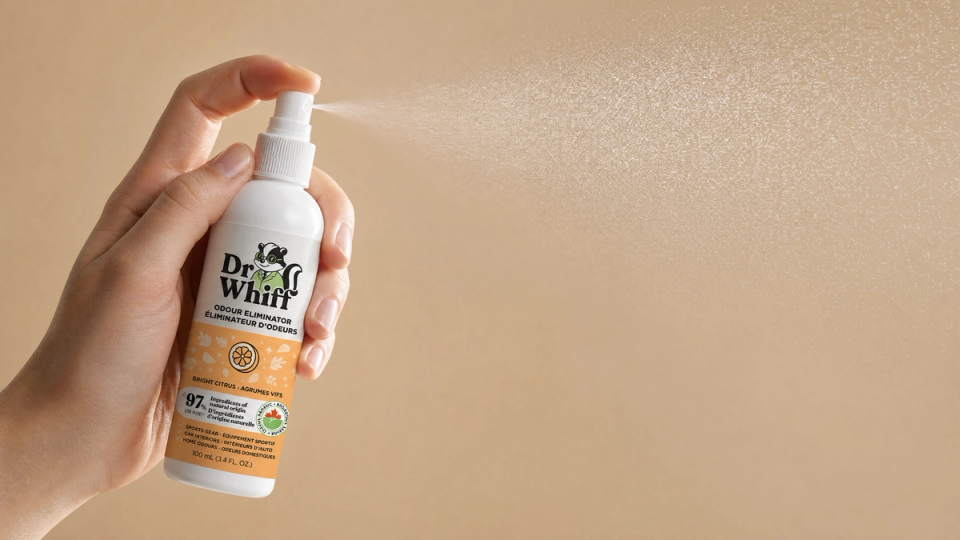
Dr. Whiff combines beneficial bacteria cultures, plant-derived surfactants, and fragrance blends so the formula breaks apart odor-causing molecules at a structural level rather than masking them. Because it works on the source, it is designed to be used right where odors live, on fabrics, upholstery, gear, and in the air. The ingredients are at least 97% naturally derived, with no phthalates and no petroleum carriers. See the full breakdown on our ingredients page and the mechanism on our odor science page.
How to choose, in one sentence
Pick a product that names how it removes odor at the source, not one that only promises a pleasant scent. If you want help comparing options, read our guide to choosing the best natural odor eliminator spray, then browse the Dr. Whiff range to find your scent.