
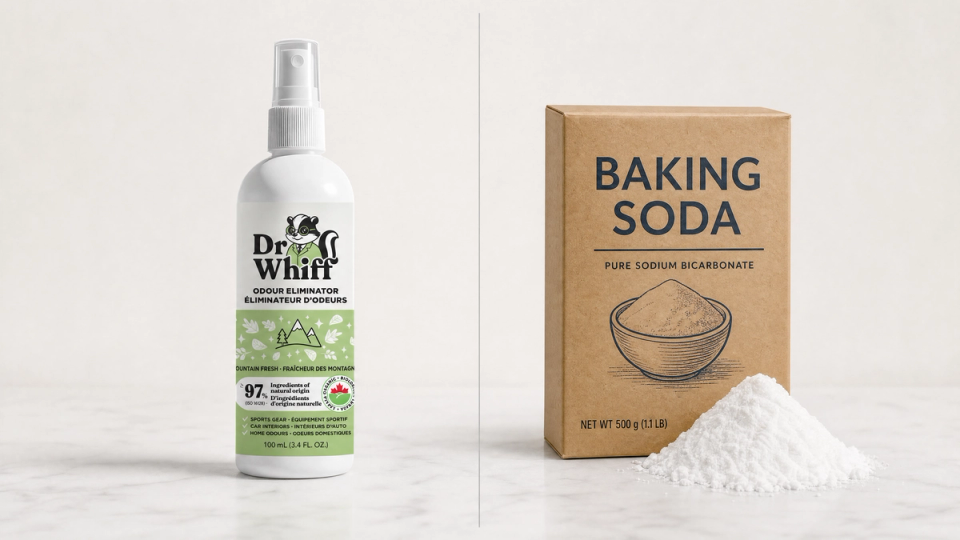
Search how to remove almost any smell and you will be told to reach for baking soda or vinegar. The advice is everywhere because, honestly, both are useful. But they are not magic, and knowing their limits saves you a lot of frustration chasing a smell with the wrong tool.
What baking soda actually does
Baking soda absorbs moisture and helps neutralize acidic odor compounds through simple chemistry. That makes it genuinely good in a few situations: an open box in the fridge, a sprinkle on a carpet or mattress before vacuuming, or a deodorizing layer in a closed container. Its strengths are also its limits. It works slowly, it has limited capacity, it needs close contact with the odor, and as a passive absorber sitting in an open room it does very little.
What vinegar actually does
Vinegar is mildly acidic, which helps it cut through some odors and break down certain residues, and it can help with mildew and bacteria on surfaces. It is useful in laundry and on hard surfaces. The catch is that vinegar has its own strong smell, it is not a fit for every material, and it does not deeply treat odors soaked into thick fabric or foam.
Where DIY remedies fall short
- Set-in odors in upholstery, mattresses, and gear, where the smell lives deeper than a surface treatment reaches. See deodorizing a mattress and upholstery.
- Biological sources like urine and vomit, which need to be broken down, not just absorbed or covered.
- Ongoing odors where the source keeps producing the smell, so a one-time absorb does not hold. That is the cycle in why smells come back after you clean.
- Convenience. DIY is fussy and slow for everyday freshening of clothes, cars, and gear.
Use DIY and a real eliminator together
This is not DIY versus a product. The smart approach uses both: baking soda for a deep absorb-and-vacuum reset, vinegar in the laundry, and a source-level odor eliminator for the everyday work and the deeper, set-in smells DIY cannot reach. For how true elimination differs from absorbing and masking, see how odor eliminators actually work.
Where Dr. Whiff comes in
Dr. Whiff handles what baking soda and vinegar cannot: it neutralizes odor at the source with beneficial bacteria cultures, works on fabrics, cars, and gear, and is at least 97% naturally derived with a light scent and no phthalates or petroleum carriers. See the formula on our ingredients page, or find your scent to round out your odor-fighting kit.